
Have you recently experienced an Anterior Cruciate Ligament (ACL) injury? Don’t worry, we’re here to help. In this article, we will explore effective rehabilitation strategies that can aid in your recovery and get you back on track. From tailored exercise routines to the use of braces and supports, we will discuss a range of techniques aimed at strengthening your knee and improving mobility. So, if you’re ready to regain your strength and functionality, let’s get started on your ACL rehabilitation journey together.
Overview of Anterior Cruciate Ligament (ACL) Injuries
Anterior Cruciate Ligament (ACL) injuries are one of the most common knee injuries, particularly among athletes involved in sports that require pivoting, sudden stops or changes in direction. The ACL is a crucial ligament that helps stabilize the knee joint, preventing excessive forward movement of the tibia (shin bone) in relation to the femur (thigh bone). ACL injuries can range from mild sprains to complete tears, and they often require prompt medical attention and appropriate rehabilitation to ensure optimal recovery.
Definition of ACL Injuries
ACL injuries occur when the ligament is stretched or torn. They can be classified into three different grades – Grade 1, Grade 2, and Grade 3. Grade 1 refers to a mild sprain, where the ligament is stretched but not torn. Grade 2 is a partial tear, where the ligament is partially torn, resulting in joint instability. Grade 3 is a complete tear, where the ligament is completely torn and the knee joint becomes highly unstable.
Causes of ACL Injuries
ACL injuries commonly occur due to non-contact mechanisms, such as sudden changes in direction, pivoting, or landing improperly from a jump. They also happen as a result of direct contact, such as a collision or blow to the knee. Athletes participating in sports like soccer, basketball, football, and skiing are at a higher risk of ACL injuries due to the nature of these activities and the forces exerted on the knee joint.
Prevalence of ACL Injuries
ACL injuries are frequently observed in sports-related settings, with a prevalence of approximately 200,000 cases reported annually in the United States alone. They are more prevalent in female athletes, with some studies suggesting that females are 2-8 times more likely to sustain an ACL injury as compared to their male counterparts. The reasons for this gender disparity are still not completely understood, but factors such as hormonal differences, anatomical variations, and neuromuscular control may contribute to the increased risk.
Types of ACL Injuries
ACL injuries can be further classified into two main types: isolated ACL injuries and combined ACL injuries. Isolated ACL injuries involve only the ACL and do not affect other structures in the knee joint. On the other hand, combined ACL injuries involve damage to other knee structures, such as the menisci, collateral ligaments, or other ligaments. The severity and treatment approach may vary depending on the type of ACL injury.
Diagnosis and Assessment of ACL Injuries
Clinical Examination
The diagnosis of ACL injuries usually starts with a thorough clinical examination conducted by a healthcare professional. The examination involves assessing the range of motion, joint stability, and the presence of any signs of injury, such as swelling or tenderness. Specific tests, such as the Lachman test or pivot shift test, may be performed to evaluate the integrity and stability of the ACL. Clinical examination provides valuable initial information about the injury and helps guide further investigations and treatment decisions.
Imaging Techniques
While clinical examination provides essential information, imaging techniques are often required to confirm the diagnosis and assess the extent of the ACL injury. Magnetic Resonance Imaging (MRI) is the most commonly used modality for visualizing ACL tears. It provides detailed images of the knee joint, allowing healthcare professionals to accurately identify the presence and severity of the injury. Other imaging techniques, such as X-rays or ultrasounds, may be used in specific cases to rule out associated injuries or assess bony structures.
Classification of ACL Injuries
After diagnosis, ACL injuries are further classified based on several factors, including the severity of the tear, involvement of other structures, and the overall stability of the knee joint. This classification helps guide the treatment plan and determines the appropriate rehabilitative protocol. The classification system commonly used is the International Knee Documentation Committee (IKDC) classification, which encompasses a grading system to describe the extent of the ACL injury.

Preoperative Considerations
Patient Evaluation
Before undergoing ACL reconstructive surgery, patients undergo a comprehensive evaluation to assess their overall health, physical fitness, and suitability for the procedure. The evaluation includes a detailed medical history, physical examination, and, in some cases, additional tests, such as blood work or electrocardiogram. This evaluation helps healthcare professionals optimize patient care, reduce surgical risks, and tailor the rehabilitation process according to individual needs.
Prehabilitation
Prehabilitation, or prehab, refers to the process of preparing the patient both physically and mentally before surgery. It aims to optimize the patient’s overall condition, enhance muscle strength, improve joint flexibility, and reduce pain and inflammation. Prehabilitation may involve a combination of exercises, such as range of motion exercises, strength training, and cardiovascular conditioning. It also includes patient education regarding postoperative expectations and rehabilitation goals.
Surgical Timing and Planning
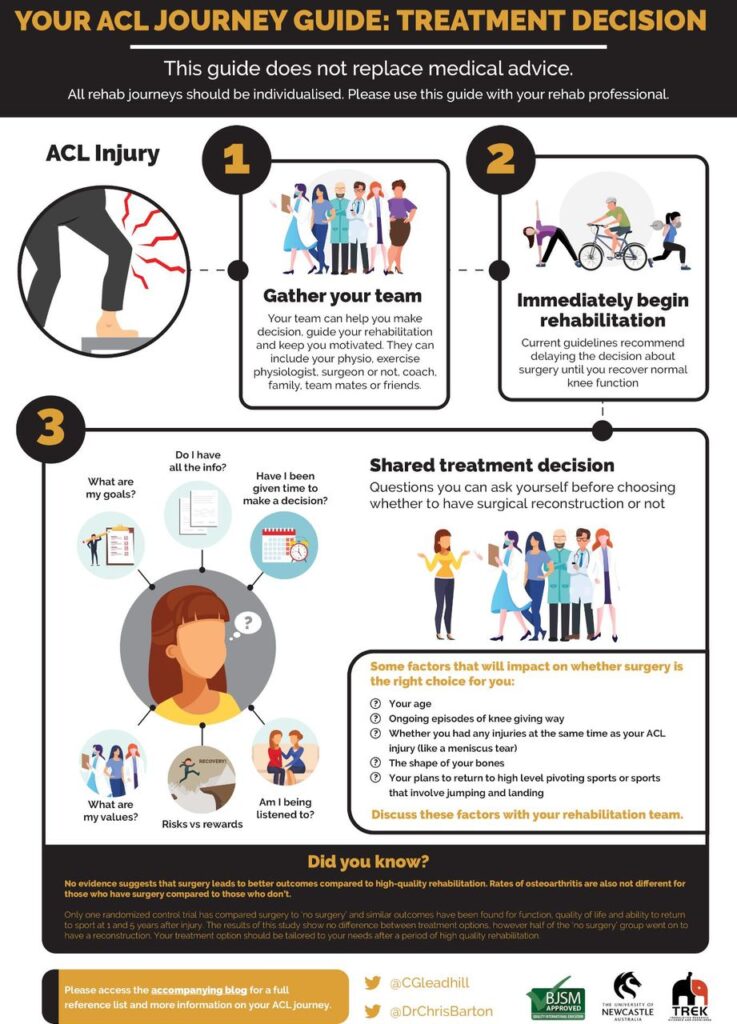
The timing of ACL reconstructive surgery is an essential consideration and may vary depending on various factors, including the extent of the injury, the patient’s overall health, and the individual’s goals or requirements. Generally, it is recommended to wait until the knee has regained full range of motion, the swelling has subsided, and muscle strength and neuromuscular control have been restored to a satisfactory level. Planning for surgery involves coordinating with the healthcare team, scheduling the procedure, and ensuring proper preoperative instructions are followed.
Postoperative Rehabilitation Phases
Phase 1: Acute Rehabilitation
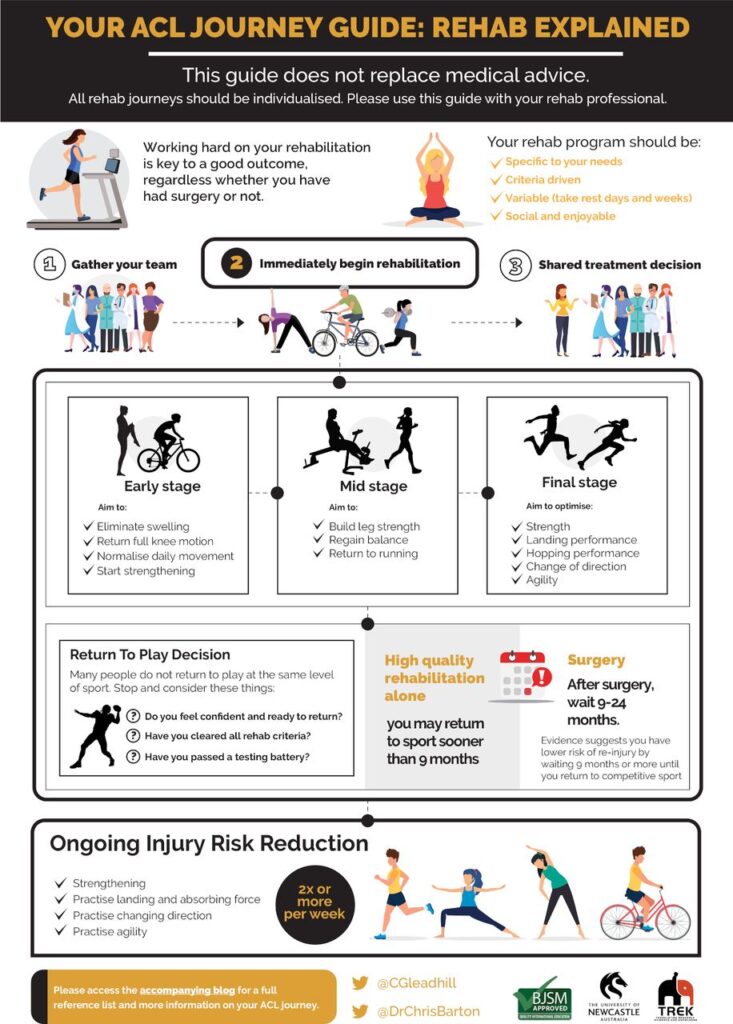
The first phase of postoperative rehabilitation typically begins immediately after ACL reconstructive surgery. The goals of this phase primarily focus on managing pain and swelling, regaining full knee extension, and initiating early range of motion exercises. Techniques such as ice application, compression, and elevation (RICE) are commonly used to manage pain and edema. Additionally, gentle range of motion exercises under the guidance of a physical therapist are introduced to prevent joint stiffness and promote healing.
Phase 2: Intermediate Rehabilitation
Once the initial phase is completed, patients progress to the intermediate rehabilitation phase. The objectives of this stage are to enhance muscular strength, improve joint stability, and restore functional mobility. Patients engage in various exercises that target muscle strengthening, particularly focusing on the quadriceps, hamstrings, and hip muscles. Proprioception and balance training exercises are also incorporated to improve joint stability and reduce the risk of future injuries.
Phase 3: Advanced Rehabilitation
In the advanced rehabilitation phase, patients transition from basic exercises to more challenging activities that mimic real-life movements and sport-specific demands. The primary goals of this phase are to further enhance strength, improve agility, and develop power and control. Plyometric exercises, such as jumping and hopping drills, are implemented to improve explosive movements. Additionally, sport-specific drills and training are introduced to simulate the demands of the specific sport in which the patient participates.
Phase 4: Return to Sport
The final phase of rehabilitation focuses on the safe and gradual return to sport activities. Specific criteria determined by the healthcare team are used to assess the patient’s readiness to return to sport. These criteria often include factors such as regained strength and endurance, passing functional performance tests, and demonstrating proper technique and movement control. A gradual return to sport protocol is followed, which gradually increases the intensity and complexity of training sessions. Psychological support is crucial during this phase to ensure the patient is mentally prepared and confident to return to their pre-injury level of performance.
Complications and Risk Factors
Graft Failure
Graft failure refers to the inability of the reconstructed ACL to provide the necessary stability and proper joint function. It can occur due to various reasons, such as inadequate surgical technique, poor graft fixation, or improper rehabilitation. To minimize the risk of graft failure, it is crucial to follow the postoperative rehabilitation protocol diligently, maintain proper surgical technique, and address any potential issues promptly.
Re-injury
Re-injury to the ACL can occur even after successful surgery and rehabilitation. This risk is influenced by several factors, including anatomical structure, functional stability of the knee joint, individual biomechanics, and adherence to proper training techniques. To reduce the likelihood of re-injury, it is essential to continue with maintenance exercises, sports-specific training, and adhere to proper movement patterns and mechanics during sports activities.
Pain and Stiffness
Pain and stiffness are common complications following ACL reconstructive surgery. Effective pain management strategies, such as medications, physical modalities, and appropriate rehabilitation techniques, help alleviate discomfort and facilitate functional recovery. Physical therapy interventions, including manual techniques and appropriate exercises, are crucial to minimize joint stiffness and regain full range of motion.
Psychological Aspects
ACL injuries can have significant psychological implications, such as anxiety, fear of re-injury, and reduced self-confidence. These factors can impact the patient’s overall recovery and return to sport process. Psychological support, including counseling, education, and goal setting, is vital to address these issues and help patients develop a positive mindset and regain confidence in their abilities.
Conclusion
Understanding and managing ACL injuries is crucial to ensure optimal recovery and a successful return to normal activities, particularly sports. A multi-disciplinary approach, involving healthcare professionals, physical therapists, and athletic trainers, is essential in providing comprehensive care throughout the entire rehabilitation process. By following appropriate rehabilitation protocols, addressing potential complications, and providing adequate support, individuals can overcome ACL injuries and regain strength and function in their knees, ultimately returning to their desired level of activity.
